There is a moment many thoughtful NLP practitioners recognise. You have trained well, collected techniques, maybe even reached Master Practitioner level. You know how to reframe, collapse anchors, run language patterns and follow protocols. Yet in the room with a real client, especially a complex or “messy” case, something still feels missing.
You may notice it when a client goes off on tangents, dissociates halfway through a technique or reacts much more strongly than the demo ever suggested. A part of you knows there is a deeper, more fluid way of working, the kind of work Erickson was famous for, but it does not always show up when you need it most. Our most recent Ericksonian and indirect hypnosis cohort was full of people who knew that feeling very well.
How NLP gave us the structure, but not always the trance
Early NLP did something remarkable. It captured language patterns, strategies and processes from Erickson and other therapists and turned them into models that could be taught. Many of us first met Erickson through the Milton Model, a few classic inductions, and some memorable stories. This opened the door to a more flexible, conversational way of working than traditional authoritarian hypnosis.
At the same time, a lot of what made Erickson’s work so effective sat underneath the models. The subtle trance management. The way he watched breathing, micro‑movements and skin tone. The way he used natural phenomena, humour, and “difficult” responses as part of the process. Much of that lived experience did not always make it into standard NLP practitioner trainings. Many people learned what to say, without ever feeling completely at home in how to be with a client in trance.
The practitioners in our last cohort were not beginners. They arrived with NLP qualifications, existing practices, and plenty of techniques. What they wanted was to put back the missing layers, so that their NLP and coaching could rest on a deeper, more Ericksonian base.
Before the course: knowing the models, still feeling script‑bound
If you had walked into the room on the first weekend and asked people quietly why they were there, you would have heard similar themes.
Some felt confident as long as the client followed the protocol, but tense when the client did something unexpected. Others knew they were relying too heavily on scripts or fixed sequences, even though they longed to improvise more. A few had already experimented with unscripted work, but found themselves worrying about safety, abreactions or “losing the plot” mid‑session.
Underneath all of that sat a very human question. “I know these change models are powerful. So why does my work sometimes feel a bit flat or mechanical.” Very often the answer was not “learn more content”, it was “learn to notice and use what is already happening, moment by moment, in the client”. That is where Ericksonian trance skills come in.
What this group spent four weekends actually learning
Over four weekends we slowed everything right down. Instead of racing through techniques, we unpacked the processes that usually sit behind the scenes. Much of the learning looked simple from the outside, but it changed how people felt in the room.
We began with observation and utilisation. Practitioners practised becoming human biofeedback monitors, tracking breathing, blinking, stillness, shifts in posture and tone. They learnt how fixation of attention and minimal cues can become natural, conversational inductions, rather than set pieces you “do” to someone. The more they really saw their clients, the less they needed to cling to a script.
We spent time with Ericksonian frameworks such as multi‑stage paradigm shifts. Instead of hoping one technique would land, practitioners had a map for helping clients move from problem trance, through loosening old beliefs, into new experiences and future possibilities. That map meant they could improvise safely. They knew where they were in the process, even when the words were not pre‑planned.
We explored indirect language, metaphors, binds and double binds in a way that fitted each person’s natural voice. That often included humour, gentle exaggeration and “My friend John”‑style stories, not as performance, but as a way to help clients loosen their grip on old narratives. For some, simply discovering that they could be themselves and still work deeply was a turning point.
Along the way we touched the quietly essential pieces that many courses skim over. Handling abreactions without drama. Working with content‑free processes when the story is too raw to tell. Using leisure‑interest and self‑hypnosis approaches so clients can continue the work between sessions. Dealing with distractions in the room without losing the flow of trance.
How their sessions feel different now
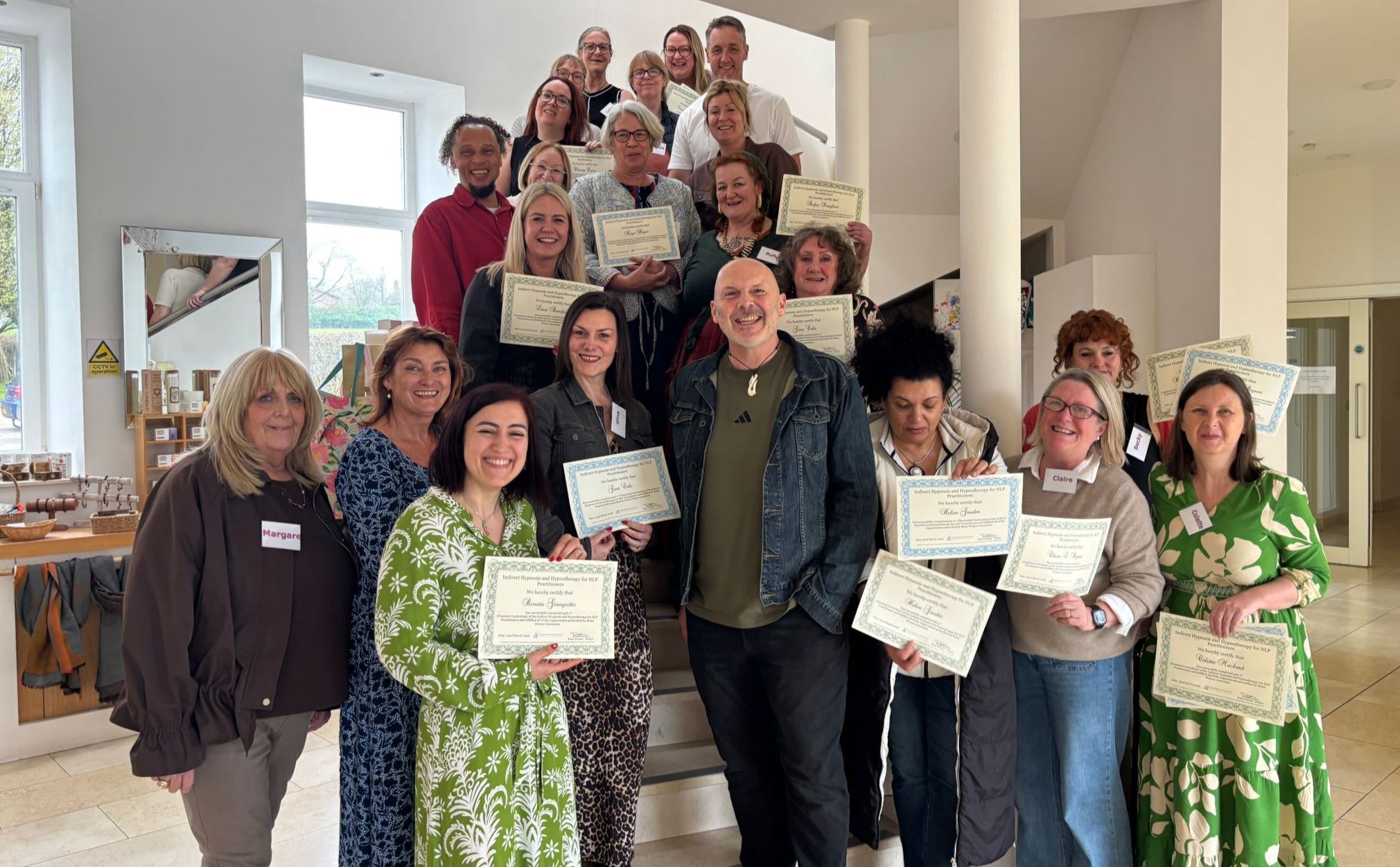
By the final weekend, the photo you see of this cohort holding their certificates was more than a record of attendance. For many, it marked a shift in how they experienced their own work. When they talked about their client sessions, there were some common changes.
Several described feeling calmer when clients did something unexpected. Instead of thinking, “the technique is going wrong”, they could notice the breathing, the gaze, the micro‑movements, and use those responses as part of the process. Others spoke about enjoying their sessions more, because they were no longer mentally juggling a script. They could keep a light touch on the framework and let the interaction breathe.
People noticed that they were picking up on minimal cues they would previously have missed. A hand relaxing on the chair, a sudden stillness, a tiny smile in the middle of a painful story. Those details became doors into experiential shifts rather than background noise. Clients, in turn, often reported feeling more understood and less “processed”.
Some practitioners found their existing NLP tools landed more cleanly once the trance work underneath was stronger. Reframes, language patterns and time‑based techniques seemed to “stick” better when the client was already in a naturally absorbed state, rather than only half‑engaged. In a quiet way, the work started to feel more like the Ericksonian demonstrations that first inspired them.
If you recognise yourself in their “before”
If you are reading this and noticing that familiar tension in your shoulders when you think about working without a script, it probably says something important about where you are in your development. Many practitioners reach a point where more techniques are not the answer. What they need instead is a chance to rediscover the subtle trance skills that NLP originally modelled.
This does not mean throwing away everything you have learned. It means letting those tools rest on a richer base, so you can respond to real people in real rooms, rather than trying to make clients fit a neat sequence. Our Ericksonian and indirect hypnosis training for NLP practitioners in or near Blackpool is designed with exactly that in mind, for people who want their work to feel safer, more flexible and more genuinely their own.
Leave a Reply