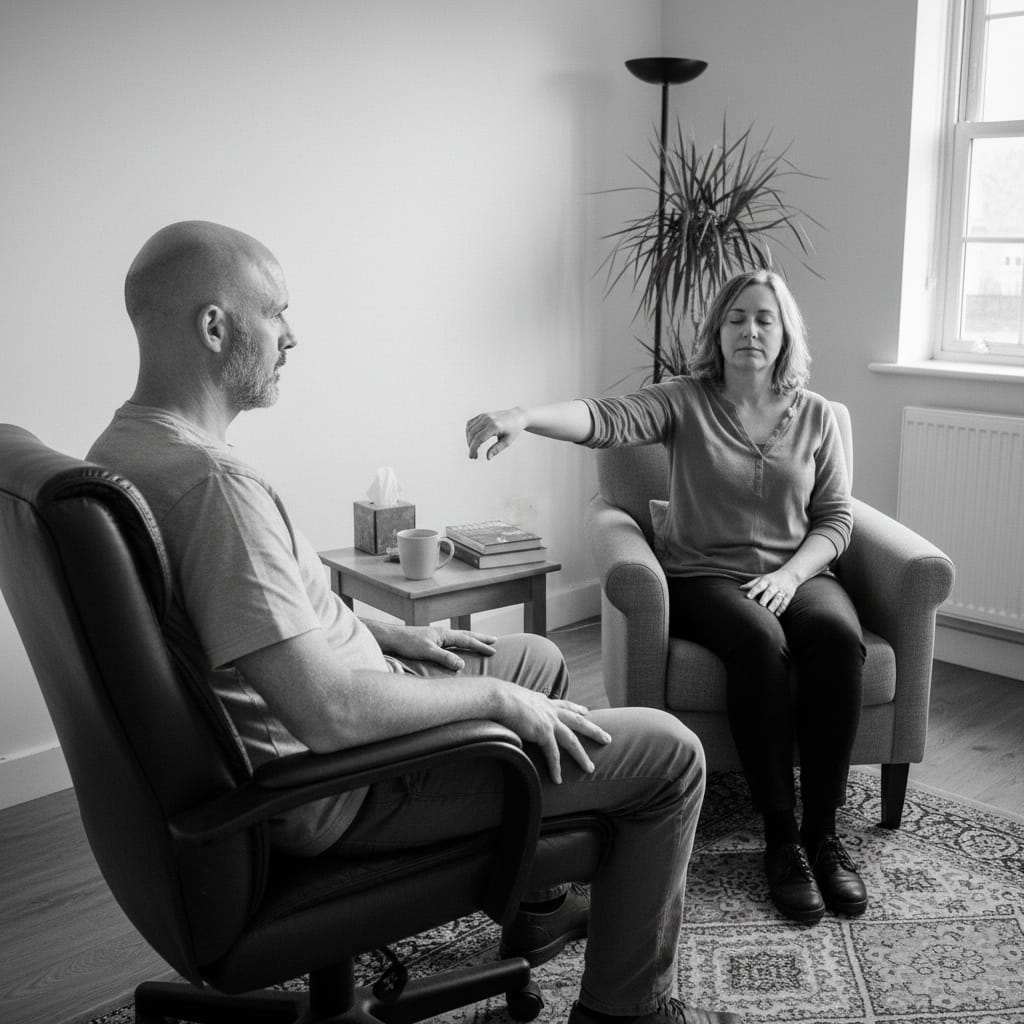
Many people in Blackpool tell me they’ve tried hypnotherapy for anxiety and left feeling relaxed but fundamentally unchanged, or worse, blamed for being “resistant”. In this article I look at why that happens, what the research says about combining hypnosis with psychotherapy, and what an Ericksonian, genuinely tailored approach can do differently.
If you’ve had that experience, you may have walked away thinking you were the problem – “too anxious”, “too analytical”, “too resistant”, “not suggestible enough”. In reality, it’s much more likely that the approach wasn’t a good fit for how change genuinely happens.
In this article I want to look honestly at why some hypnotherapy for anxiety doesn’t work, what the research says about hypnosis combined with psychotherapy, and what to look for if you’re searching for help in Blackpool or the Fylde Coast.
There are hypnotherapists… and there are hypnotherapists
Hypnotherapy isn’t one single thing, delivered in one single way.
On one end of the spectrum, there are people who take a short course, learn some generic scripts and then read those scripts at you while you sit in a chair. If those words happen to match your situation, you might feel some benefit. If they don’t, you get relaxation at best and frustration at worst.
When nothing much changes, the story can quickly become:
- “You must be resisting.”
- “Maybe you’re not ready to change yet.”
- “Some people just aren’t good subjects.”
Notice how that quietly places the blame on you?
At the other end of the spectrum, there are hypnotherapists who treat hypnosis as a collaborative, responsive process. Rather than walking in with a script, they walk in with curiosity, experience and a deep respect for the fact that your nervous system, history and resources are uniquely yours.
As Milton Erickson, whose work heavily influences how I practise, put it:
“Change will lead to insight far more often than insight will lead to change.”
In other words, real change isn’t about someone lecturing your conscious mind. It’s about creating the right kind of experience so your system can discover new possibilities from the inside.
What the research actually says: hypnosis plus psychotherapy
- A meta‑analysis of 18 studies found that when hypnosis was added to cognitive‑behavioural psychotherapy, clients did substantially better than those who received the same therapy without hypnosis; on average, those receiving the combined approach improved more than about 70% of people in the non‑hypnotic groups.
- Broader reviews and overviews of hypnosis research show that hypnosis and hypnotherapy can improve a range of mental health and medical outcomes, particularly when used as a complement to good psychotherapy, rather than in isolation.
To me, this fits common sense:
- Hypnosis can quieten the noise and give you access to more of your internal resources.
- Psychotherapy gives structure, relationship and meaning so those resources get used in useful directions.
- Together, they can help you discover shifts that are hard to reach through talk or suggestion alone.
When hypnotherapy is reduced to “someone reading a script at you”, you lose most of that richness.
Generic “anxiety scripts” often:
- Assume anxiety is the same for everyone.
- Talk at you rather than working with how your mind actually organises experience.
- Try to push you straight from “on alert” to “relaxed” without respecting the reasons your system learned to be on alert in the first place.
Anxiety is rarely just “thoughts”. It’s a pattern involving:
- Sensations in the body.
- Fast, learned predictions about danger and safety.
- Old experiences that still colour the present, even when you can’t consciously link them.
- Protective strategies that once made sense, even if they’re now uncomfortable or outdated.
A scripted session that doesn’t notice or work with those layers will often feel like it skims the surface. You might enjoy the hour, but your everyday life doesn’t move much.
What an Ericksonian approach does differently
Milton Erickson worked from a simple but radical assumption:
We all have within us the resources needed for change; the task of therapy is to help us find and use those resources in new ways.
That sounds abstract, but it has very concrete implications for how I work with anxiety in Blackpool:
- I don’t come into the room with a fixed script.
- I listen carefully to how you describe your experience – the metaphors you use, the ways your body responds, the situations where anxiety flares and the ones where you surprise yourself.
- I use indirect suggestion, stories, imagery and conversation to help your unconscious mind explore options that don’t fit into neat, pre‑written paragraphs.
- I pay close attention to your responses moment‑by‑moment, adjusting what we do in real time instead of ploughing on regardless.
In effect, we’re co‑creating a bespoke intervention for you, rather than trying to squeeze you into a pigeon‑hole that was never designed for your life.
Sometimes that looks like:
- Helping a part of you that is always on guard to finally feel that someone else (even for a moment) is sharing the watch.
- Finding memories of times when you handled uncertainty better than you expected, and using those as a template for future experience.
- Working with your body’s own rhythms – breath, posture, micro‑movements – so “calm” becomes something you do, not just something you try to think.
When it seems like you’re “too anxious for hypnosis”
A lot of people tell me:
“I don’t think hypnosis would work for me. I’m too anxious, too in my head, I can’t switch off.”
From an Ericksonian perspective, that’s often a sign that hypnosis – done well – could be particularly helpful.
If your system is already highly focused, scanning and imagining worst‑case scenarios, you are already doing something very much like hypnosis – just in a direction that hurts. The question isn’t “Can you go into trance?” but “Can we help that skill point somewhere more useful?”
In practice, that means:
- We don’t insist you close your eyes or relax on command.
- We use your natural anxious focus and rapid thinking as material, not as an obstacle.
- You stay in charge: you can talk, move, ask questions. Hypnosis is a way of focusing, not a loss of control.
If a previous hypnotherapist told you that you “couldn’t be hypnotised” or “must be resisting”, it may simply mean their approach wasn’t adaptable enough for the way your mind works.
What to look for in a hypnotherapist for anxiety in Blackpool
If you’re considering trying again after a disappointing experience, here are some questions you might quietly ask yourself when you look at a therapist’s website, or speak with them:
- Do they talk about scripts, or about tailoring the work to you?
- Do they recognise that anxiety shows up in the body as well as the mind?
- Do they mention combining hypnosis with psychotherapy, or do they treat hypnosis as a standalone magic trick?
- Do you get a sense that they’re interested in your actual life, or just in applying a technique?
You don’t need to interrogate anyone – often you can feel the difference between “one‑size‑fits‑all” and “let’s genuinely understand how this works for you”.
Doing things differently in Blackpool
In my own work in Blackpool and across the Fylde Coast, sessions for anxiety and panic are usually 90 minutes. That gives us enough space to:
- Understand how anxiety works for you in real situations.
- Use Ericksonian and NLP approaches to shift patterns at the level of experience, not just ideas.
- Give you something practical to notice or play with between sessions, so change can unfold in daily life, not just in the therapy room.
Sometimes, a single piece of work makes a noticeable difference. More often, there is a series of shifts – in how you sleep, how you brace (or don’t) before social contact, how long a spike of anxiety lasts before it settles.
What matters to me is not that you become a perfect, perpetually calm person (no such thing), but that anxiety stops running the whole show.
If previous hypnotherapy for anxiety hasn’t worked
If you’ve tried hypnotherapy before and felt let down, it doesn’t mean you’re broken or beyond help. It probably means you’ve met one particular style of work that wasn’t enough for what you needed.
If you’d like to explore a more tailored, Ericksonian‑informed way of working with anxiety in Blackpool, you’re welcome to read more about my anxiety and panic hypnotherapy in Blackpool or get in touch if you’d like to ask a question before booking.
Leave a Reply